Simple
A text. No app.
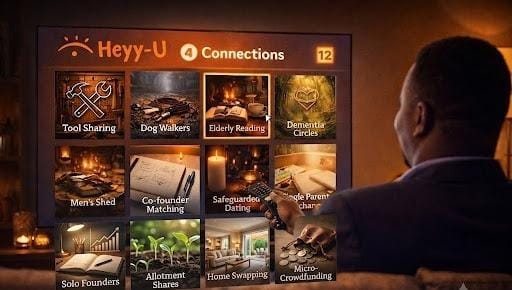
A man sits alone in a warm room. In front of him: the glowing rectangle that has, for a decade, promised connection and delivered a feed. He lifts the remote — and this time the screen doesn't pull him deeper in. It points him out. Toward a reading circle, a Men's Shed, a five-a-side team, a neighbour who is also alone tonight.
Heyy-U turns the tools that isolated us into a doorway back to each other.
Simple. Measurable. Instant. Private.
This is the single source of truth for Heyy-U — the vision, the product, the architecture, the money, the go-to-market, and the roadmap. Every technical claim is tagged with an honest maturity marker: Live shipped and demonstrable · Designed specified, not yet built · Aspirational requires a partner or licence to become real. Show partners the vision freely. Disclose the tagged internals only after signature.
Whenever a decision is hard — a feature, a price, a partner term, a line of copy — it resolves against these four. If a choice makes Heyy-U less simple, less measurable, less instant, or less private, it is the wrong choice.
Heyy-U is a consent-first human connection protocol that lets anyone reach anyone — a person, a community, a business, an event — by ordinary text message, using a sovereign @handle, with no app to download, no feed to scroll, no algorithm, and no data sold. We describe it as the Visa of human connection: not the bank, not the merchant, the rails in between that make a billion small transactions of trust possible.
A transient routing layer between two consenting people. We hold no relational graph to sell. When a message has passed, the link decouples. We are the switch, not the destination.
We charge per useful message and per functional transaction — never per eyeball, never per hour of engagement. A dormant handle costs almost nothing. A handle that helps people meet is where value lives.
Privacy is not a setting we grant; it is the shape of the system. The sender never sees the recipient's number. We aim to hold the mapping only as long as a conversation is live. Suppression is silent — a non-answer, not a rejection.
Every other platform's success metric is time-on-app. Ours is the opposite: the moment two people agree to meet at 2pm on Thursday, we have succeeded and we get out of the way. We measure outgress, not engagement.
Two things are true at once. Screens have become the primary mediator of human contact — and the primary obstacle to it. The same rectangle that could summon a neighbour instead serves an infinite feed engineered to keep you seated and alone.
The attention economy discovered that loneliness is profitable. A feed that leaves you slightly emptier is a feed you return to. That is the shared adversary — quietly named, never shouted — behind everything Heyy-U does. We are not another walled garden competing for the same evening hours. We are the exit door, built on the humblest, most universal technology there is: the text message.
Netflix taught the world to stream film. Heyy-U teaches the world to stream connection — and download real life. The carousel of tiles on the screen looks familiar on purpose. But every tile, instead of pulling you deeper into the sofa, ends with you off it.
This is the whole product in four steps. A person sees a tile, presses one button, receives one text, replies once — and is now expected somewhere real. No app was downloaded. No password was set. No profile was built.
The genius of the loop is what it omits. There is no onboarding funnel, no email verification, no "download our app to continue." The television becomes the discovery surface; the phone the person already owns becomes the secure channel; and the relay does the introduction. The heaviest thing anyone installs is a single reply.
The barrier that kills community adoption is removed. Your grandmother can join a reading circle from her sofa.
Nothing to breach, nothing to sell, nothing to regret having shared. Identity lives on the SIM, not in our database.
There is nowhere to endlessly scroll. The interaction has a beginning, a purpose, and an end — a meeting.
This section describes the system as designed. Some of it runs today; much of it is a specification that becomes real only with a mobile-network partner. We mark every layer so that no one — least of all us — mistakes the blueprint for the building.
Commercial logic and live proof points are shown to anyone, before any NDA. The routing internals, handle-registry design, and MNO-integration model below are shown only after signature. This page is the internal master; the partner-facing versions redact accordingly.
A standard text leaves a phone carrying its real number (MSISDN). In the designed system, that traffic reaches a gateway which maps the raw number to a handle-registry node and shields the real number from every other party. The sender only ever sees a handle.
We do not assign a unique number to every person — that would never scale. Instead a single relay routes everyone through an identity-translation layer. When one person texts another's handle, the system maps the verified incoming number to an active session and appends a session wrapper (for example, [From @tendai]), so countless two-way conversations run concurrently on one pipe without collision.
| Dimension | Traditional apps | The Heyy-U protocol |
|---|---|---|
| Architecture | Siloed walled gardens | Native SMS cellular layer |
| Data model | Behavioural harvesting & cookies | Transient proxy, minimal retention |
| Identity | Email — bot-vulnerable | Carrier-authenticated SIM / MSISDN |
| Monetisation | Attention & ad exploitation | Utility & micro-yield transactions |
| Objective | Endless passive scrolling | Physical community outgress |
The system is designed to act as a structural firewall between two communicating parties — a decoupled routing layer that never needs to build a predatory relational database in order to make money. That is the architectural expression of the DNA.
Heyy-U deliberately touches lonely people, elderly people, children's activity groups, grief and recovery contexts. That is precisely where a naïve "text anyone" system becomes dangerous. Safety is therefore not a feature bolted on; it is a set of gates every message passes through.
Raw inbound texts are filtered before they ever reach a person. Language screening flags hostile or manipulative syntax at the switch. Beyond that, senders are sorted into trust tiers, and the most sensitive handles cannot even be activated without formal verification.
One flagship use — texting a vehicle by its number plate handle ("your lights are on") — is also the one most open to abuse. A stranger could use false urgency to lure a driver out of a safe place. The relay is built to defeat exactly this.
A stranger texting a plate handle triggers a system-authored safety notice: "Unlinked sender — reply via proxy or press 999." The direct human message is never delivered raw.
If an unlinked stranger sends high-urgency language ('fire', 'open your window'), custom text is blocked entirely. The platform substitutes a sterile, authoritative message: "Do not leave your home. Check from a window." Natural human suspicion is backed by a telco-grade shield.
Even the artwork obeys the safety rule: interest tiles never feature identifiable human faces — only evocative objects (a leather football on wet grass, a candle, a garden trowel) representing the collective interest. This protects the user base and pre-empts regulator concern before it is raised.
The cost model scales per useful message and per transaction, not per handle. A dormant handle is almost free — which is why we can give handles away and still make the economics work. High-status commercial demand and local supply chains cross-subsidise the public-good handles that will never be monetised at all. The tier names are a permanent framework.
Aphrodite and Poseidon pay so that Artemis and Hermes don't have to. Rented commercial handles lease temporary access to the functional proxy switch only — they never see historic subscriber lists or SIM identities. Commerce funds the commons; it never gets to mine it.
Where a transaction is involved — an entry fee, a ticket, a small donation to a community treasury — it settles on the SIM itself, not through a card redirect. This is the mechanism that turns everyday community activity into self-funding neighbourhood treasuries, and it depends entirely on a carrier billing agreement.
Not per handle. Register a million dormant handles and the cost floor barely moves. This inverts the usual land-grab pressure.
The handles that generate volume — marketplaces, events, businesses — are the ones that pay. Value tracks usefulness.
Because commerce cross-subsidises, the food bank, the reading circle, and the grief mailbox never see a bill.
The interface people see is a carousel of cinematic tiles that looks and feels like a streaming service — deliberately familiar, so no one has to learn anything. But where a streaming tile ends in more watching, a Heyy-U tile ends in a text, a handshake, and a meeting. The library already spans 100+ interests across sport, civic life, care, creativity, and commerce.
Grassroots football, badminton, running groups, cricket, hiking — the low-friction on-ramps.
Allotment shares, tool circles, food banks, postcode noticeboards, neighbourhood watch.
Elderly reading, dementia circles, grief mailboxes, Men's Shed, carer respite — handled with the most safeguarding.
Freelancer clusters, co-founder matching, remittance, cooperative banking nodes, safeguarded dating.
Every tile shares two constants: the trademarked Doorway glyph (the arch with a centre dot, signalling universal SMS connectivity) top-left, and a category line-icon top-right. The variable is a high-definition, photoreal, object-only background. Palette: navy #0A1628, plum #5D1C6A, gold #C9A84C, teal #00B4A6, ember #D4541A. Type: Fraunces display, Inter body, IBM Plex Mono for data. (Original brand notes specify Playfair Display / Source Serif — this master uses a close, freely-embeddable pairing; swap to the licensed brand faces for production.)
Replaces the passive "send us your videos" QR code on broadcasts. During a global tournament, a production desk can switch the on-screen master target to a specific national flag handle (e.g. @heyy-u234 for Nigeria), turning isolated fans texting in into a live, screened engine of national unity. Fan replies scroll as a sterile, screened ticker — never raw.
A rural inventor texts an idea to @submitbusinessidea. An automated NDA loop asks them to reply AGREE to lock a legal signature, then deposits a sterile abstract into a producer vault — bypassing social-media algorithms entirely and protecting broadcasters from unsolicited-IP lawsuits. Heyy-U retains the generic handle and leases the traffic flow for a season.
The single most important strategic principle: large partnership conversations follow demonstrated community traction — they never precede it. The temptation is to lead with the BBC, the MNOs, the celebrity handle. The discipline is to lead with organisers who are drowning in group-chat admin and hand them something better.
@zim-london — roughly 1,847 members across 12 UK cities — is the replicable proof point. It is not a slide; it is a living community reachable by text today. The entire GTM is: replicate that, 500 times.
Make the handle self-serve and make organisers the sales force. No business-development team, no pitch decks, no partnership gating for the core motion — just a handle name, a card form, and an SMS confirmation the organiser forwards to their existing group chat.
No mobile operator will license Heyy-U and no broadcaster will co-produce until there is a real, sizeable, verified subscriber base. You do not need them to get there. You need them after. Get to 500 handles first; the institutional doors open on their own.
Heyy-U runs several partnership tracks in parallel, each shaped to the partner's own published priorities. The framing tool across all of them is a quietly-held shared adversary: the attention-extraction economy that monetises loneliness. We never shout it. We let the contrast speak.
The proposal is a zero-capital MVP pilot on existing broadcast infrastructure. The BBC contributes a small engineering team and Ofcom sandbox sponsorship for a 90-day sprint; Heyy-U delivers the session engine, the tile library, and global format-licensing rights via BBC Studios. Crucially, the money firewall keeps revenue off the public screen: community treasuries belong to communities, and any commercial upside routes through BBC's commercial arm, keeping the public-service broadcast Ofcom-clean.
| BBC input | Heyy-U delivers | Structural guarantee |
|---|---|---|
| 2 frontend engineers | Middleware session engine | Brand in front; "technology by Heyy-U" credit |
| 1 system architect | 150+ proprietary UI tiles | Money firewall — revenue off the public screen |
| Ofcom sandbox sponsorship (90-day sprint) | Global format licensing via BBC Studios | Charter fit — conquers loneliness, serves regions equitably |
The flagship co-production concept: a diaspora-focused global tournament where national flag handles turn a broadcast into a live engine of connection across a 10-million-strong UK diaspora sublayer. It is the diaspora flag hub at Charter scale. Designed
Revenue surfaced rather than firewalled — pitched via Partner Lab and indie co-development routes, tuned to a commercial public-service remit.
Full licensing proposal aligned to each operator's published innovation programme. This is the track that turns the Aspirational architecture into Live capability — and Lebara is the strongest mission-aligned MVNO for a first pilot.
Heyy-U as the member-side layer, JoinIt as the organisation-side layer. An existing customer relationship becomes a partnership: their membership backend, our SMS reach.
Structured term sheets for a sports-vertical partner and a chief-architecture partner. The sports vertical is the primary revenue engine — parent league handles (e.g. @lboro-league) capture entry fees and ticketing off the public screen, while team sub-handles stay organiser-owned.
For any public-service partner, Heyy-U offers something no ad-funded platform can: a bot-free public-value scorecard from day one. Every response is backed by a physical, carrier-authenticated SIM, so VPN spoofing and click-farms are neutralised. Reach, quality, real-world impact (physical outgress) and micro-treasury value can be stratified geographically without violating individual privacy. It measures serendipity as an auditable number. Designed
Return to the man in the warm room. The old story ends with him still there at midnight, lit blue, alone. The Heyy-U story ends with an empty chair and a text on his phone: "Welcome. We're meeting Thursday at 2." Everything in this document — the relay, the tiers, the Pantheon, the roadmap — exists to make that one substitution: the screen that took people from each other, handing them back. Simple. Measurable. Instant. Private. Human.